The full press release is available below : PRESS RELEASE
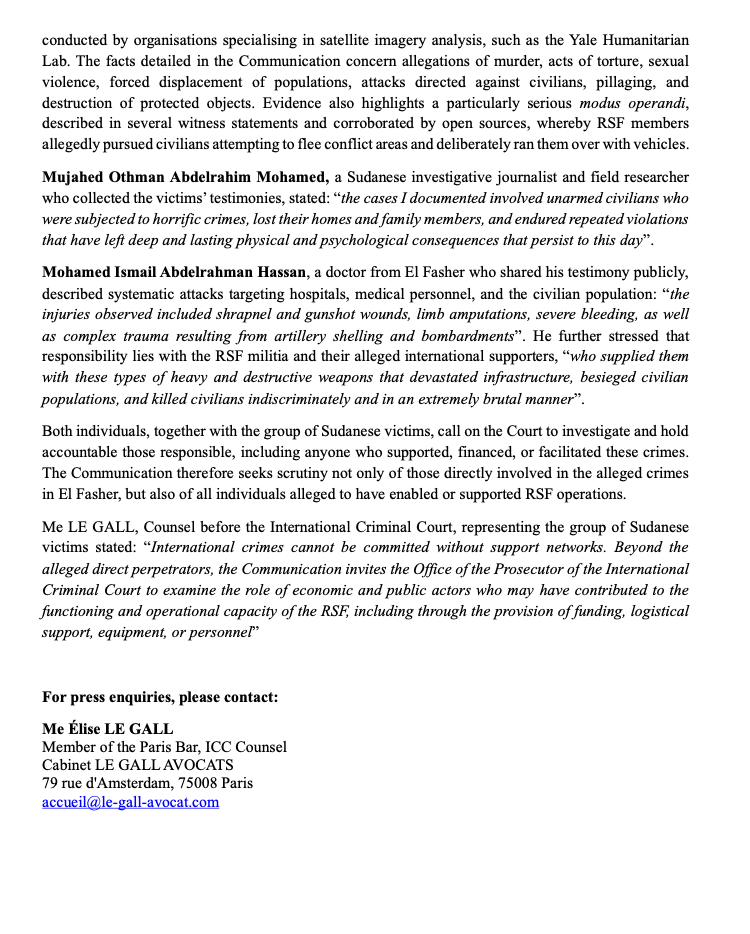
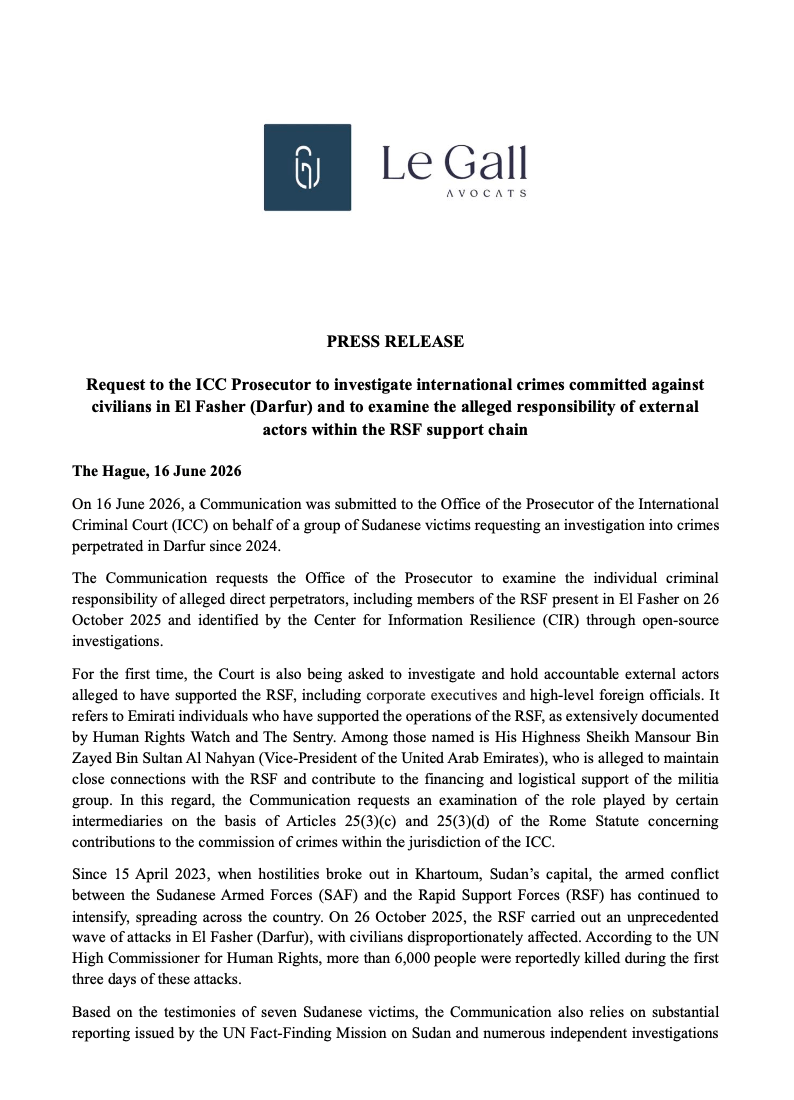
On 16 June 2026, a communication was sent to the Office of the Prosecutor of the International Criminal Court (ICC) on behalf of a group of Sudanese victims, requesting the opening of an investigation into alleged international crimes committed in the Darfur region, and more specifically in El Fasher.
This submission forms part of the context of the armed conflict that has been ongoing since April 2023 between the Sudanese Armed Forces (SAF) and the Rapid Support Forces (RSF), a conflict which has caused a major humanitarian crisis and numerous serious violations of the fundamental rights of the civilian population.
Allegations of particularly serious international crimes
The submission is based on victims’ testimonies, field investigations, and reports and analyses produced by international bodies and organisations specialising in documenting human rights violations.
The facts submitted for the Office of the Prosecutor’s consideration relate in particular to allegations of crimes against humanity and/or war crimes involving the following underlying acts:
- killings of civilians;
- acts of torture;
- sexual violence;
- forced displacement of populations;
- attacks directed against civilians;
- looting;
- destruction of protected property.
The evidence presented also relates to the attacks carried out in El Fasher from 26 October 2025 onwards, which are alleged to have caused a particularly high number of civilian casualties.
Examination of the responsibility of the direct perpetrators and alleged supporters
The submission calls on the Office of the Prosecutor to examine the individual criminal responsibility of those who may have been directly involved in the commission of the alleged crimes.
Furthermore, the submission is not limited to requesting an examination of the responsibility of the alleged perpetrators present on the ground. It also calls on the Office of the Prosecutor to analyse the role of individuals who are alleged to have contributed, directly or indirectly, to the functioning, funding and operational capacity of the Rapid Support Forces (RSF).
In this regard, the submission draws on several public investigations and reports documenting the existence of external support networks that enabled the RSF to continue its military operations in Darfur. This evidence refers in particular to financial, logistical and material support that may have strengthened the capabilities of this militia during the conflict.
The communication therefore calls on the Office of the Prosecutor to examine whether certain individuals – including business leaders, financial intermediaries and senior foreign officials – may have played a role in providing resources, funding, equipment, logistical support or personnel that contributed to RSF operations.
Among the individuals mentioned are certain nationals of the United Arab Emirates, including His Highness Sheikh Mansour Bin Zayed Bin Sultan Al Nahyan, whose potential role is raised in light of information made public by several international organisations and independent investigative bodies. In this regard, the submission requests that the Court examine whether certain forms of external support may have constituted a contribution to the commission of crimes falling within the jurisdiction of the ICC. This analysis is sought in particular in the light of Articles 25(3)(c) and 25(3)(d) of the Rome Statute, which provide for the criminal liability of any person who aids, abets or makes a significant contribution to the commission of international crimes.
This approach is based on a fundamental principle of international criminal law: mass crimes are often not solely the work of their direct perpetrators, but may also be made possible by networks providing financial, economic, logistical or political support. The submission therefore calls on the Office of the Prosecutor to examine the entire chain of responsibility in order to determine whether certain individuals may have knowingly contributed to maintaining or developing the operational capabilities of the RSF.
The role of victims in international proceedings
This initiative aims, above all, to ensure that Sudanese victims are heard and to bring acts of exceptional gravity before international criminal justice.
The fight against impunity for international crimes requires an examination of all forms of responsibility that may have contributed to their commission, whether they concern the direct perpetrators or those who may have facilitated or supported these acts.
As a lawyer at the International Criminal Court, Ms Élise LE GALL represents the group of victims behind this submission and is assisting them in their efforts to ensure that the alleged offences are subject to a thorough examination by the Office of the Prosecutor of the ICC.